Skip to content
Leak search and repair across Miami-Dade

Refrigerant leak repair in Miami, FL

Refrigerant does not get used up. If a system is low, it is leaking, and topping it off every summer just pays to vent refrigerant into the air. We find the leak, fix it where it makes sense, and charge the system by weight.

  • Answered 24/7
  • Same-day repair visits
  • Miami-Dade and Broward
  • Written price first

We repair and install Carrier, Trane, Lennox, Daikin, Mitsubishi Electric and every other major brand found in Miami homes.

CarrierTraneLennoxRheemGoodmanDaikinMitsubishi ElectricAmerican StandardBryantRuudFujitsuLGYorkAmanaCarrierTraneLennoxRheemGoodmanDaikinMitsubishi ElectricAmerican StandardBryantRuudFujitsuLGYorkAmanaCarrierTraneLennoxRheemGoodmanDaikinMitsubishi ElectricAmerican StandardBryantRuudFujitsuLGYorkAmana

Quick answer

Refrigerant leak repair means locating where refrigerant is escaping, usually at the evaporator coil, a flare fitting, a Schrader valve or a rubbed line set, then repairing it, pulling a deep vacuum and recharging to the manufacturer's specification. In Miami, formicary corrosion of copper coils is one of the most common causes.

Written by Sylvia Denton, HVAC Guides Editor. Updated 2026-09-22.

A sealed refrigerant system should hold the same charge for its whole life. When a Miami homeowner tells us the unit gets a recharge every June, that is a leak being paid for over and over. Each recharge costs money, lets the compressor run hot and underfed between visits, and releases refrigerant that the EPA now regulates more tightly than ever.

Finding a leak takes patience. We start with pressure readings and superheat to confirm the system really is low, then work through an electronic detector, bubble solution on fittings, and when needed a nitrogen pressure test or UV dye. The most common locations we find in Miami-Dade are the indoor evaporator coil, Schrader valve cores, flare nuts on mini-splits, and line sets that rub against a wall bracket or were nicked by a lawn trimmer.

Once the leak is located, you get the options in writing: repair in place, replace the component, or, on an older system still running R-22 or a badly corroded coil, put that money toward replacement instead.
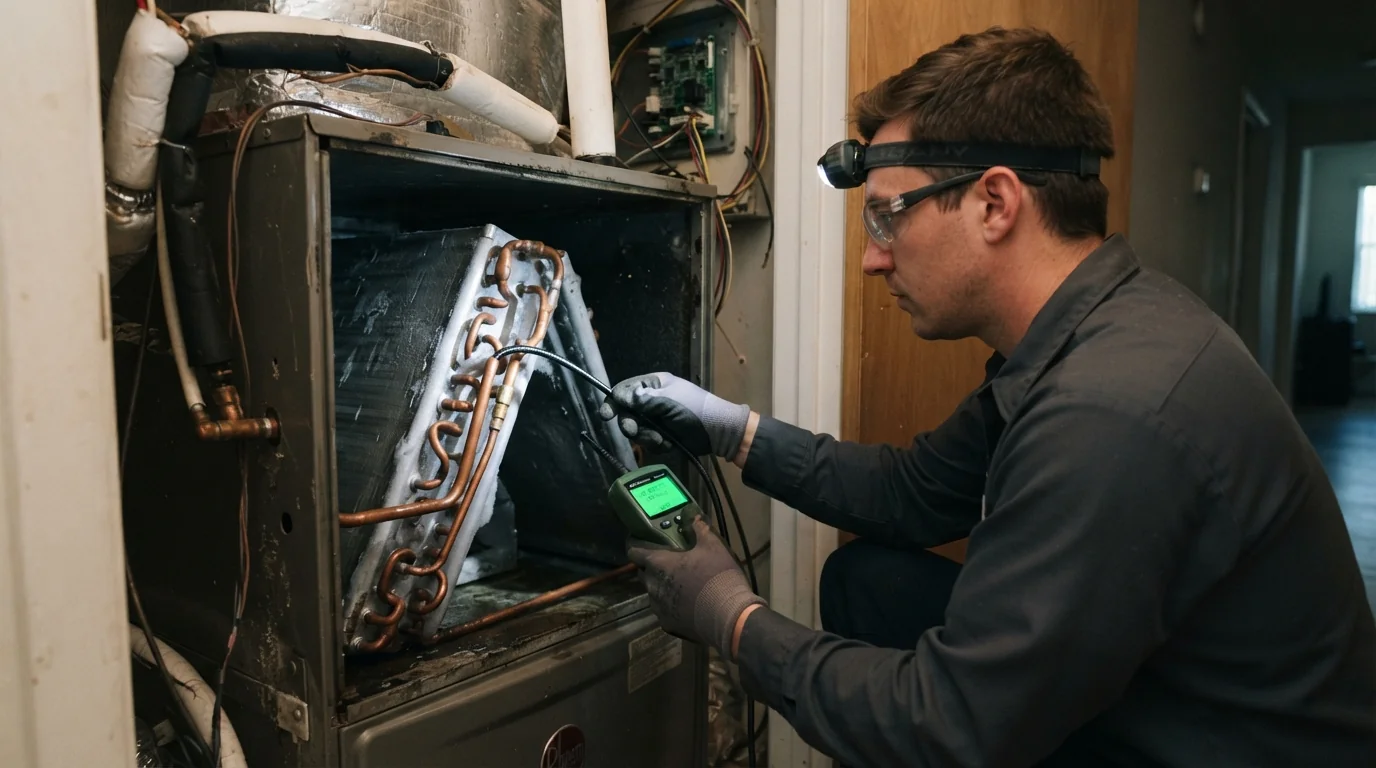
Technician holding an electronic refrigerant leak detector probe against copper tubing on an evaporator coil inside an opened Miami closet air handler
Warning signs

Signs of a refrigerant leak

Needed a recharge before

If any technician has added refrigerant in the past, the leak that caused it is almost certainly still there.

Ice on the copper line

Low charge drops coil pressure until moisture freezes on the suction line and the indoor coil.

Longer run times, higher bills

The system runs longer to do less, and the FPL bill climbs without a change in weather or habits.

Hissing near the unit

A sharp hiss at the condenser or air handler can be a larger leak at a fitting or a cracked line.

Warm air on the hottest days

A slightly undercharged system copes in the morning and falls behind by mid-afternoon.

Oily residue on fittings

Refrigerant carries compressor oil, so a greasy spot on a joint or valve often marks the leak.

Process

How a leak repair runs

  1. 1

    Confirm the charge is low

    Pressures, superheat and subcooling are measured so nobody chases a leak that is not there.

  2. 2

    Search the system

    Electronic detection, bubble testing, and if needed nitrogen pressure or dye to pinpoint the spot.

  3. 3

    Repair or replace

    Brazing a line, replacing a valve core or fitting, or swapping the coil, depending on where the leak is.

  4. 4

    Pressure test and vacuum

    The repair holds nitrogen pressure, then the system is evacuated below 500 microns to remove moisture.

  5. 5

    Charge by weight

    Refrigerant goes in by the manufacturer's specification, then superheat and subcooling confirm it.

Pricing

Refrigerant leak repair costs in Miami

$225 to $445Leak search

Electronic and bubble testing; nitrogen or dye adds time on hard leaks.

$185 to $395Valve core or flare repair

Small, common leaks at service ports and mini-split fittings.

$345 to $865Line set repair

Brazing a rubbed or cut section, then pressure testing.

$1,480 to $2,960Evaporator coil replacement

Often covered for parts under warranty on newer systems; labor still applies.

$145 to $620Recharge by weight

Depends on the refrigerant type and how many pounds the system holds.

Typical Miami-Dade ranges for 2026, not a quote. R-22 systems are expensive to recharge because that refrigerant is no longer produced; on those we will show you the replacement comparison.

Local context

Why Miami coils leak

Most evaporator coils leak through a form of corrosion called formicary corrosion: tiny pinholes that eat through copper tubing from the inside out. Warm, humid air and household chemicals, from cleaning products to new cabinetry, speed it up. Miami's climate keeps coils wet for most of the year, which is why we see coil leaks here on systems as young as six or seven years old.

Outside, salt air near Biscayne Bay and the Atlantic attacks condenser coils and fittings, and condensers in Key Biscayne, Miami Beach and Coconut Grove show corrosion years earlier than units in Doral or West Kendall. Lawn trimmers and vibrating wall brackets cause the rest, rubbing through the insulated line set until the copper wears thin.

The refrigerant itself is changing too. New equipment sold since 2025 uses A2L refrigerants such as R-454B and R-32. R-410A is still available for servicing existing systems, but its price has climbed, which makes repairing a leak more worthwhile than recharging around it.

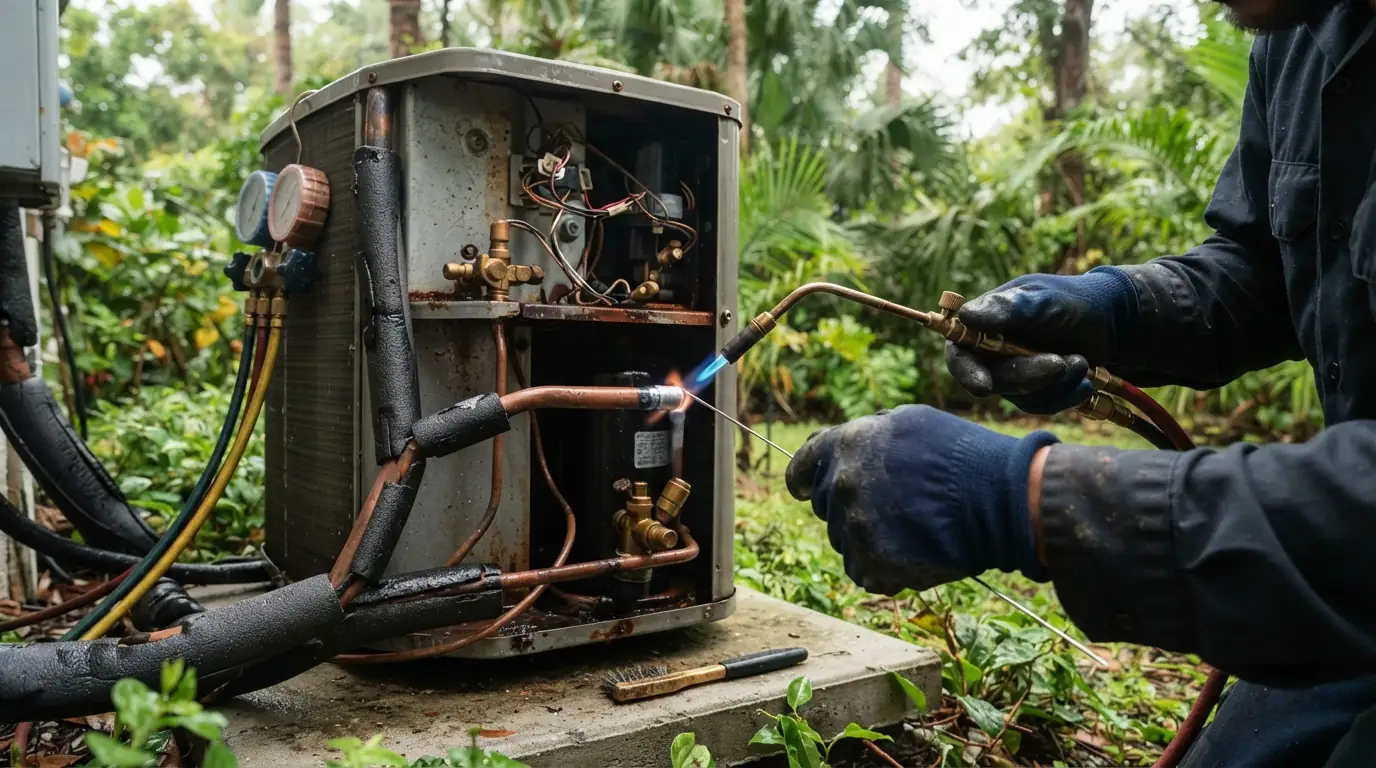
Close detail photo for refrigerant leak repair in a Miami property: technicians hands at the repair or replace step
Why us

Why Miami homeowners call Vice City Cooling

We find the leak first

No top-off without a reason. A recharge without a repair is money on a timer.

Charged by weight

The correct amount goes in by specification, not by guessing at pressures on a hot day.

Deep vacuum every time

Moisture left in the system shortens compressor life, so every repair is evacuated properly.

Warranty help

We check the manufacturer's parts warranty on coils before quoting and handle the claim.

FAQ

Refrigerant leak questions

Do AC systems need refrigerant added every year?

No. A healthy system holds its charge for life. Needing refrigerant means there is a leak, and it should be found and repaired.

How long does a leak repair take?

A small valve or fitting repair can be done in one visit. A coil replacement usually takes a few hours once the part is on hand, which may mean a return trip.

Is it worth fixing a leak on an old R-22 system?

Usually not if the leak is in a coil. R-22 is no longer manufactured and is very expensive, so the repair money often makes more sense toward a new system.

Is refrigerant dangerous in my house?

Small residential leaks are not usually a health hazard in a ventilated home, but refrigerant displaces oxygen in a closed space. Newer A2L refrigerants are mildly flammable and installed with safeguards.

Will my warranty cover a leaking coil?

Many manufacturers cover the coil for ten years if the system was registered. We check the serial number and file the claim, though labor is usually not included.

Also in AC Repair

Related services

AC Not Cooling

Diagnosis and repair when the system runs but the house stays warm.

Learn more

Frozen Evaporator Coil Repair

Finding the airflow or charge problem that iced the coil.

Learn more

AC Compressor Repair

Testing, repairing or replacing a failed compressor.

Learn more

Tired of paying for a recharge every summer?

We find the leak and fix it. Same-day visits across Miami-Dade.

Call (786) 434-0401