Quick answer
Signs a Miami AC needs replacing include age over 12 to 15 years, R-22 refrigerant, repeated or expensive repairs, rising FPL bills, a house that stays humid, corroded coils and cabinets, and uneven cooling. Multiply the system's age by the repair cost; if the result is over about $5,000, replacement usually makes more sense.
Written by Sylvia Denton, HVAC Guides Editor. Updated 2026-09-22.
1. It is 12 to 15 years old or older
Miami systems run so many hours that 12 to 15 years is a normal lifespan, shorter than the 15 to 20 years you may read about for milder climates. The manufacture date is encoded in the serial number on the data plate, and a technician can read it for you.
2. It uses R-22 refrigerant
R-22 was phased out and is no longer produced. Systems that still use it are expensive to recharge, and any leak repair becomes a big bill. If your system is R-22 and needs refrigerant, replacement is almost always the better investment.
3. Repairs are getting frequent or expensive
One repair in a decade is normal. A capacitor this summer, a motor last year and a leak the year before is a pattern. Use the age times cost rule: a 13-year-old system facing a $900 repair scores $11,700, well past the point where replacement usually wins.
4. Your FPL bills keep climbing
As coils corrode and compressors wear, systems run longer to deliver the same cooling. If summer bills rise year after year without a change in how you use the house, efficiency is slipping.
5. The house stays humid
An aging system, or one that was oversized from the start, may cool the air without drying it. If the house feels clammy, closets smell musty, or mildew appears, the system is not controlling humidity, which is half its job in Miami.
6. The coils and cabinet are corroding
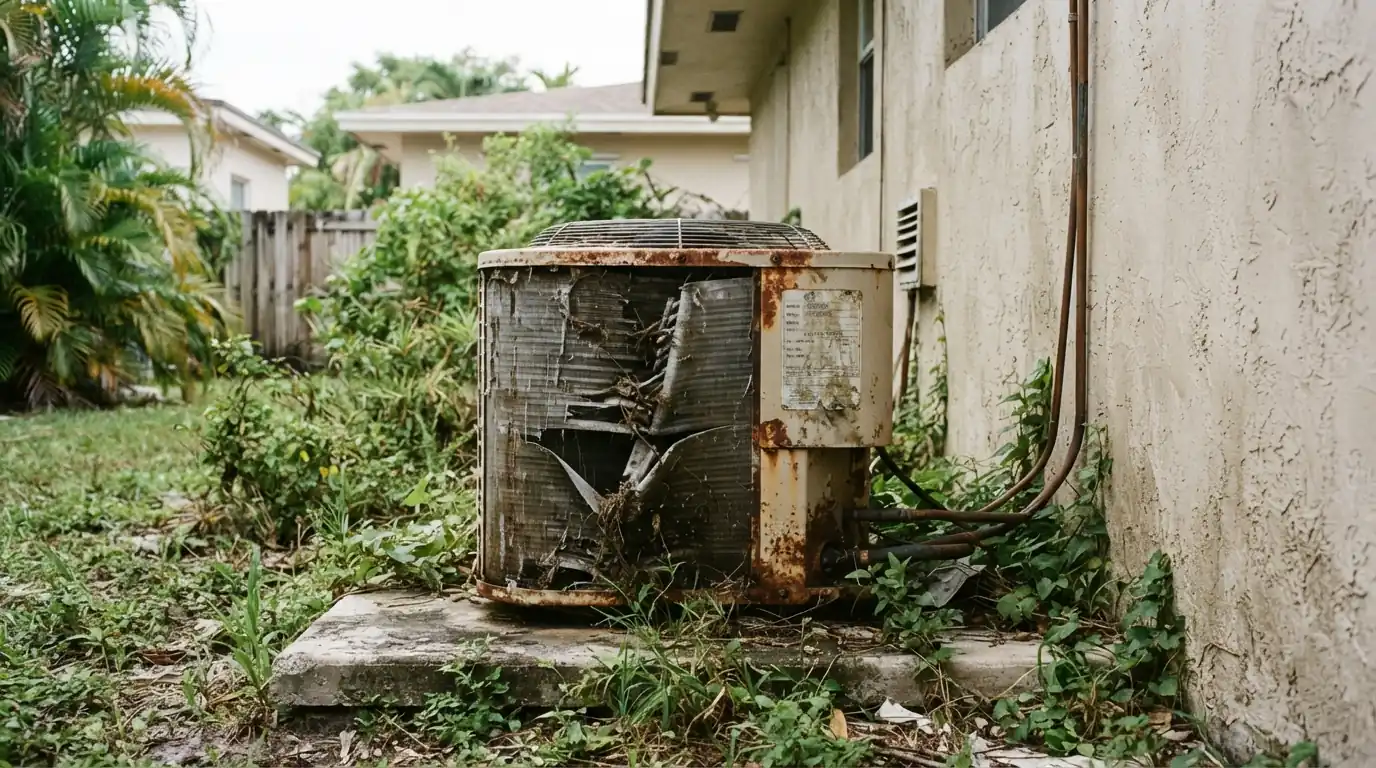
Near Biscayne Bay and the ocean, salt eats condenser coils. Fins that crumble when touched, rust through the base pan, and repeated coil leaks mean the outdoor unit is failing structurally, even if the compressor still runs.
7. Some rooms never cool
Uneven cooling can be ductwork rather than equipment, but in older systems it often signals lost capacity. A technician can measure airflow and temperature split to tell which it is.
What to do next
If two or more of these signs apply, get both a repair price and a replacement price in writing, and compare them with the age times cost rule. Replacing on your schedule, before a failure, gives you time to compare options, pick the right efficiency and line up FPL rebates.
Need a technician instead of a guide? Call (786) 434-0401; we answer 24 hours a day across Miami-Dade.